BALI - ISLAND OF THE GODS

EAT, PRAY, AND LOVE

Laman

  • HOME
  • NGABEN CEREMONY

19 March 2011

NUSA DUA BEACH

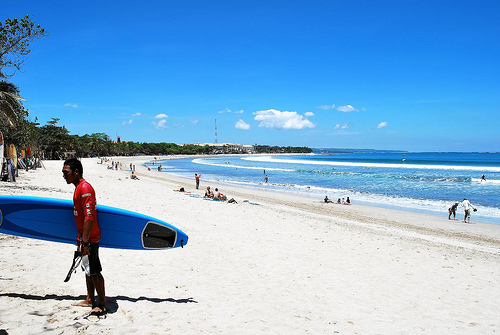
        Bali's most prestigious resort area, Nusa Dua is where the tourists will find international world, class luxury hotels elegantly lining beautiful white sands. Located on the Bukit peninsula, in the southern part of Bali, approximately 10 km from the international airport. It is quiet and exclusive with superb facilities. 


         Crystal clear water and stretches of white sandy beach of Nusa Dua makes Nusa Dua a perfect spot for luxurious resorts to which exhausted the bodies, after a Barong performance at Batubulan and a long climb of the steps of the Mother Temple Besakih, will want to rest. Some of the most sumptuous and luxurious hotels in the world find their home in Nusa Dua Bali. We can tee off into the sunset, while watching the gentle waves come from the blue sea and caress the banks surrounding the luscious greens. Tranquil swimming pools under the coconut trees seem to be one with the distant blue sea. Art galleries and numerous shops surround them.


        Nusa Dua is really about taking it easy and relaxing in total luxury. As most of the hotels are 5 stars, every comfort is at our disposal as well as a gorgeous white sand beach. Nusa Dua was designed for the luxury conscious with a heavy concentration of big name hotels lining the beautiful white sand beach. 
       
        The kind of activities on offer gives a flavor of Nusa Dua. The Bali Golf and Country Club, an immaculately landscaped 18 holes ocean view course. The Bali International Lawn Tennis & Lawn Bowls Club next to the Galleria Nusa Dua a spacious shopping mall with boutiques and up market restaurants. Close by Chandra Koka Amphitheatre provides a venue for traditional entertainment including arts festivals like the Nusa Dua Arts and Culture Festival. Stroll to the northern end of Nusa Dua for parasailing, jet skis, snorkeling/diving trips or better still, head for Tanjung Benoa.


   Some of the resorts have private beaches but most areas are accessible. The stretch past the Hilton Resort has been a public beach and during the wet season, the outer reef there is a popular surf break. At present we will find some simple warungs selling good food at cheap prices along this beautiful stretch of white sandy beach that offers excellent swimming conditions in a protected lagoon.
Posted by Sebastian at 8:52 AM 0 comments
Email ThisBlogThis!Share to XShare to FacebookShare to Pinterest
Labels: Nusa Dua Beach

KINTAMANI

        The villages of Kintamani and Penelokan provide a great view of the still active Mount Batur and its fantastic lake. Seven miles in diameter and sixty feet deep, Batur caldera is simply astounding. From Penelokan, take the road Kedisan on the shores of the lake where boats can be rented to cross over to Trunyan.


        The spectacular mountainous region around Kintamani with its deep Crater Lake and bubbling hot springs, make this region a must to visit. Batur Lake is the largest lake in Bali and the region offers some of the most spectacular views to be found anywhere on the island. Batur Lake also provides water for an underground network of streams and springs across the southern slopes of the mountain. Kintamani is really great for day trips, trekking or simply for getting away from it all for a few days.


        The district is the earliest known kingdom in Bali, dating from the tenth century. The evenings get cool up here but it's well worth the stay overnight to climb the volcano and watch the sunrise. Many cheap cottages are available here.

        Kintamani can run through Payangan or from Denpasar through the Sangeh monkey forest, Plaga and Lampu, arriving to the north of Kintamani. Bemos to Kintamani are available from Ubud via Sakah (notable for its huge "Baby" statue). They also run via Tampaksiring and Bangli. From Denpasar bemos leave for Kintamani from the Batubulan terminal until late afternoon.


        Tour to Kintamani is a very impressive experience where Kintamani Area have very beautiful panorama located in plateau and also encircled by mountain atmosphere with the windblast from Mount Batur. Carpet of Batur Lake seen far below and also there are local resident house beside of Batur Lake. Beside of that, Mount Batur which to date still be active growing its beautiful for Kintamani Area.

Posted by Sebastian at 8:41 AM 0 comments
Email ThisBlogThis!Share to XShare to FacebookShare to Pinterest
Labels: Kintamani

18 March 2011

GARUDA WISNU KENCANA

Garuda Wisnu Kencana  (GWK)

Cultural Park Bali, shocases the art and culture


GWK

        GWK Cultural Park is intended to educate, especially the young generations about the importance of preserving and cultivating world’s cultural heritage.
        Situated on a limestone escarpment overlooking the South Bali tourist region, Garuda Wisnu Kencana Cultural Park shocases the art and culture of the Island of the Gods amid dramatic natural backdrops and breathtaking panoramic vistas. Located fiften minutes from the international airport and less than an hour from most major hotels and resorts, GWK is one of the island's premier venues for artistic performances, exhibitions, and conferences as well as for sightseeing and relaxation.


GWK 

         The statue and its pedestal will be surrounded by more than 240 hectares cultural park which was once an abandoned and unproductive limestone quarry. The cultural park will provide attractions for both local and foreign visitors with supporting facilities such as Lotus Pond, Festival Park, Amphitheater, Street Theater, Exhibition Hall, as well as Jendela Bali The Panoramic Resto and souvenir shop.

         At present time, the statue of Wisnu, the statue of Garuda, and the hands of Wisnu have been placed temporarily in three different plazas within the park.


MODERN RENDERINGS OF ANCIENT TRADITION
GWK2

         Dominating the park is Wisnu, a bust of a Hindu deity constructed from giants slabs of copper and brass. Representing the divine force responsible for the protection of the universe, the 22 meter Wisnu figure is a modern rendering of an ancient cultural tradition. The companion piece, Garuda, represent the giant bird which transports Wisnu, a symbol of both freedom and selfless devotion.

         The two 25-meter natural limestone pillars comprising the
Gapura Batu, at the entrance gate to the complex, are carved with images taken from the Ramayana, the Mythical cycle of stories forming the dramatic basis of most Balinese art forms. The base-relief carving on the gate depict scenes from the Wayang, the shadow puppet theatre unique to Bali and neighbouring Java.


gwk 

A PLACE OF SPIRITUAL PILGRIMAGE

         
Adjacent to Wisnu figure is the Pahrayangan Somaka Giri, a sacred spring from which flows water containing a rich mixture of ninerals. As the existence of the spring in these arid limestone hills has no scientific explanation, it has become a place of pilgrimage and meditation. The water is believed to cure disease, and is widely used by local conjurers in ritual to invoke rain in order to ensure good crops


The Statue of Wisnu

GWK 

         As the anchor point of GWK, the 20 meter tall copper statue of the Lord Wisnu has been placed temporarily on the highest hill of Ungasan where visitors can enjoy sunset or sunrise over the magnificent view of Kuta, Benoa and Sanur.

          The statue of Wisnu is an illustration of the Almighty God in maintaining and caring all life and its being. The god Wisnu is the owner of Amerta in the form of water as the source of fertility , giving wealth and life to the universe.

The Statue of Garuda

GWK 

          Right behind the Plaza Wisnu is the Plaza Garuda where the 18 meters tall statue of Garuda placed temporarily.

         At the present time, Plaza Garuda becomes the focal point of a massive alley of carved limestone pillars which covers more than 4000 sqm open space area namely Lotus Pond. The colossal limestone pillars and monumental Garuda statue make Lotus Pond a very exotic space. With its room capacity that can accommodate up to 7000 people, Lotus Pond has gained good reputation as the perfect place to hold big and international events.

Daily Events

          Not only showcasing fascinating tourism destination, everyday GWK also present you many Indonesian traditional music and dances, especially Balinese.

          Your arrival will be greeted by Barong Dance with Balinese gamelan music at the Street Theater. A beautifully played Rindik – Balinese traditional music – will accompany your whole journey while enjoying the view and the luxury of every venue in GWK. While you enjoy our Amphitheater, you can watch some dancers practicing for the Kecak Dance show and Tektekan collaboration which you can see live as GWK’s presentation for your unforgettable arts and cultural experience.

gwk01_b

The Venues

           With little rainfall and open to fresh tropical breeze, GWK facilities are ideal for all types of events, be it private or public, small or big, local or international.

          The first class acoustic environment of the 800 seat Amphitheater is peerless venue for intimate cultural performance. Enclosed by enormous limestone pillars with the Garuda figure as a backdrop, the dramatic Lotus Pond area has capacity at 7500, like the ceremonial boulevard of Balinese village.

         The Street Theater is suitable for processions, fashion show, and other mobile performances. The most intimate space, the Plaza Kura-Kura can hold 200 participants. In addition to the open public spaces, the Exhibition Gallery provides 200 square of covered area as well as ten square meter internal open courtyard. The newest venue in GWK is Indraloka Garden. With a beautiful view, it is one of the most appealing place for wedding and dinner party.


jendela-bali-gwk

Jendela Bali The Panoramic Resto

         Designed as a viewing café with the spectacular panorama of Bali, Jendela Bali Restaurant and Café is the most suitable place to end the day where visitors can enjoy the sunset and put the climax of their visit to GWK Cultural Park.

resto

The Authentic Balinese Cuisine

  • Iga Sapi Bakar // Grilled spicy beef ribs served with banana leaf-wrapped rice and mixed salad
  • Nasi Campur Bukit // Balinese tumpeng, served with shredded beef, spicy chicken curry, seafood satay, omellete, grilled snapper and vegetables urab.
  • Sop Buntut // Ox-tail soup served with banana leaf-wrapped rice
  • Bebek Betutu // Half Balinese duck braised in betutu’s herb. Served with sautéed water spinach and banana leaf-wrapped rice.
  • Balinese Pizza // Thin crust pizzatopped with tomato sauce, mozzarella cheese and shredded spicy grilled chicken

GWK Souvenir Shop

Get specially designed GWK merchandise only here in GWK Souvenir Shop.


Gwk shop 
         Our special collectible item is a miniature of the colossal Garuda Wisnu Kencana (GWK) statue which come in various scale (1:100, 1:500, 1:1000). This limited item is a perfect souvenir for your family and friends back home.
You can also get other GWK merchandise to remember your memorable visit to GWK Cultural Park. Unique T-shirt, keychain, mug, etc are available for purchase with affordable price at GWK Souvenir Shop.


The Story of Garuda Wisnu Kencana

         Here is the story of Garuda Wisnu Kencana which follow the birth and deeds of the mythical bird Garuda as quoted from Wikipedia. You can find this story carved into stone relief, placed in GWK Street Theater.

GWK story 

        The story of Garuda’s birth and deeds is told in the first book of the great epic Mahabharata. According to the epic, when Garuda first burst forth from his egg, he appeared as a raging inferno equal to the cosmic conflagration that consumes the world at the end of every age. Frightened, the gods begged him for mercy. Garuda, hearing their plea, reduced himself in size and energy.

       Garuda’s father was the creator-rishi Kasyapa. His mother was Vinata, whose sister was Kadru, the mother of serpents. One day, Vinata entered into and lost a foolish bet, as a result of which she became enslaved to her sister.

       Mahabharata mentions about a bet between sisters and wives of Kashyapa, Vinata and Kadru, about the colour of Uchchaihshravas‘s tail. While Vinata, the mother of Garuda and Aruna, said it was white, Kadru said it was black.

       The loser would have to serve as a servant of the winner. Kadru told her sons, Naga (“serpent”), to cover the tail of the horse and thus make it appear as black in colour and thus, Kadru won.

gwk 

         Resolving to release his mother from this state of bondage, Garuda approached the serpents and asked them what it would take to purchase her freedom.

         Their reply was that Garuda would have to bring them the elixir of immortality, also called amrita. It was a tall order. The amrita at that time found itself in the possession of the gods, who guarded it jealously, since it was the source of their immortality. They had ringed the elixir with a massive fire that covered the sky.

         They had blocked the way to the elixir with a fierce mechanical contraption of sharp rotating blades. And finally, they had stationed two gigantic poisonous snakes next to the elixir as deadly guardians.

         Undaunted, Garuda hastened toward the abode of the gods intent on robbing them of their treasure. Knowing of his design, the gods met him in full battle-array. Garuda, however, defeated the entire host and scattered them in all directions. Taking the water of many rivers into his mouth, he extinguished the protective fire the gods had thrown up. Reducing his size, he crept past the rotating blades of their murderous machine. And finally, he mangled the two gigantic serpents they had posted as guards. Taking the elixir into his mouth without swallowing it, he launched again into the air and headed toward the eagerly waiting serpents.

         En route, he encountered Vishnu. Rather than fight, the two exchanged promises. Vishnu promised Garuda the gift of immortality even without drinking from the elixir, and Garuda promised to become Vishnu’s mount.
Flying onward, he met Indra the god of the sky. Another exchange of promises occurred. Garuda promised that once he had delivered the elixir, thus fulfilling the request of the serpents, he would make it possible for Indra to regain possession of the elixir and to take it back to the gods. Indra in turn promised Garuda the serpents as food.

          At long last, Garuda alighted in front of the waiting serpents. Placing the elixir on the grass, and thereby liberating his mother Vinata from her servitude, he urged the serpents to perform their religious ablutions before consuming it. As they hurried off to do so, Indra swooped in to make off with the elixir.
From that day onward, Garuda was the ally of the gods and the trusty mount of Vishnu, as well as the implacable enemy of snakes, upon whom he preyed at every opportunity.
Posted by Sebastian at 10:11 AM 0 comments
Email ThisBlogThis!Share to XShare to FacebookShare to Pinterest
Labels: GWK

16 March 2011

KUTA BEACH


        Kuta Beach is a tourist spot located in the south of Denpasar, the capital of Bali, Indonesia. Kuta is located in Badung. This area is a tourist destination abroad, and has become a mainstay tourist island of Bali since the early 70's. Kuta Beach is often referred to as sunset beach as opposed to the Sanur beach.

Kuta Beach


        Kuta became known when the merchants from Denmark to open trade representative office here. Trading relationship that exists between the trade representative with the original native population and then develop very rapidly.

       
New start in 1930 a married couple from California Americans are very impressed with the beauty of Kuta beach, who was totally unspoiled human intervention, the alias is still natural. Kuta Beach Hotel is the first hotel that stands in the region, but unfortunately have to be closed because the Japanese army invaded the island of Bali at the time. In 1960 when many Australian tourists who had a stopover in Bali for a trip to Europe, Kuta started getting known again. In the process, the more interesting areas of Kuta tourist visits not only from Australia, but also from various parts of the world.
Quickly stand various hotels along the Kuta beach area. Usually the hotels area of this international standard, or at least an international hotel group. Starting from the early end of Kuta beach there is Inna Kuta Beach Hotel, Hard Rock Hotel, Mercure Hotel, etc.. Also stands a very comfortable inn boutique style resort that is Nature Kulkul Boutique and Resort.


         The most crowded time at Kuta beach is in the evening or during sunset (sunset). All whether foreign or local tourist gathered into one here. Moreover, there are special moments in the country such as school holidays, Idul Fitri holidays or New Year holiday, we can be sure the crowd was getting into.


          Kuta beach, visitors can make surfing or surfing, playing soccer, flying kites, just lying on the warm beach sand, or wash the eyes of Western tourists watched the sun. If interested in the services ponytail hair or temporary tattoo, it can also be obtained at this beach.
Indonesia is a country rich in beautiful beaches. Indonesia therefore become one of the world tourist destination. Many tourists are tempted to feel the beauty of the sunset and sunrise from the beach Indonesia. For surfers, beach Indonesia is a paradise for big waves and can race them in the surf andrenalin.


          So many beaches that can be surfing destination, and even still many unexplored beaches that are still impressed pure.  I’ll show you some spot best  surfing. Because Indonesia is a vast country and many areas that have the potential to surf. 


Posted by Sebastian at 12:48 PM 0 comments
Email ThisBlogThis!Share to XShare to FacebookShare to Pinterest
Labels: Kuta Beach

SANGEH

        
         It is located near to Sangeh village; the renowned 6 hectares of Bali Sangeh Monkey Forest are filled with giant nutmeg trees capable of growing as high as 40m. Sangeh Monkey Forest near the village of Sangeh, in southwestern Bali, has six hectares of forestland with giant nutmeg trees. The main attractions here are the hordes of funny yet wise Balinese monkeys inhabiting both the trees and the temple, Pura Bukit Sari, found in the heart of the forest. The monkeys of the forest are believed to be sacred and indeed will approach anyone paying respects at the temple. But visitors should be aware that these monkeys are attracted to shiny objects, so cameras and jeweler should be left behind or kept well hidden under clothes or in a bag when exploring Sangeh Bali.


        Near Sangeh village, about 20 km north of Denpasar. This forest of approximately 6 hectares is filled with giant nutmeg trees that can grow up to 40m high. The main attractions are the hordes of Balinese monkeys that inhabit the trees and the temple, Pura Bukit sari, located in the heart of the forest. The temple, Pura Bukit Sari, was originally built around the 17th century as an agricultural temple and has been restored several times, most recently in 1973. In the central courtyard, a large statue of Garuda, an old carving of uncertain date, symbolizes freedom from suffering and the attainment of amerta, the elixir of life. The forest of nutmeg trees in which it lies was presumably planted


Posted by Sebastian at 9:00 AM 0 comments
Email ThisBlogThis!Share to XShare to FacebookShare to Pinterest
Labels: Sangeh

LOVINA BEACH

        Near the northern tip of the island of Bali lies a stretch of villages by the Bali Sea. Lovina Beach is the name. Lovina is really a string of coastal villages to the west of Singaraja. Escape from the hustle and bustle of Kuta to Lovina Beach located in north Bali, about 100 kilometers from southern tourist hotspots. It is well known as an excellent site for sunset watching, snorkeling, and diving.


        Darkly beautiful, Lovina offers quiet and calm, and is popular Asian tourists and those avoiding the hustle and bustle of the southern beaches. A number of coves offer tranquil, protected waters and Lovina is one of them. 

        Although the sand is grey, it is quiet and peaceful, and popular among those who shun the glitzier beach resorts of the south. It is a popular place for dolphin watching; dolphins play in the water off Lovina. Famous for its early morning dolphin-watching boat trips, Lovina also offers good snorkeling and diving, and trekking in the nearby mountains. Diving off Menjangan Island, part of the Bali Barat National Park, is generally regarded as the best in Bali. Boats are readily available to take divers over to the island, where there are no residents or hotels.

         Nightlife activities are also abound, as well as chartered boats to go out into the sea. If we like what Kuta offers but do not like the crowd. With a wonderful variety of hotels, restaurants and bars located on or very near the calm beach, Lovina offers something for everyone. It is also a good base to take day trips to the nearby attractions of north and west Bali.


Posted by Sebastian at 8:55 AM 0 comments
Email ThisBlogThis!Share to XShare to FacebookShare to Pinterest
Labels: Lovina Beach

LEGIAN BEACH

        Close to the Kuta action but far enough for some down time, Legian is less hectic than downtown Kuta but still has a funky nightlife zone. Legian is a no-holds barred beach where locals, expatriates and tourists mingle, bargain with the best, play paddle ball and football, indulge in a massage and manicure, catch up on reading, meditate, exercise. Legian and Seminyak were small villages a few years ago a short distance from Kuta. 


         Over the last few years, accommodation has expanded around Legian with many simple family-owned guest houses upgraded; complemented by boutique style hotels and first class hotels. Kuta is literally five-minute taxi ride away. Sunset is peak time at Legian Beach, when the beach bars fill up, the football field is at its busiest and the locals knock off work and wade fully clothed, skirts swirling, into the waves. Now part of the greater Kuta area, both offer quieter alternatives and a more sophisticated nightlife scene focusing on dining-out and socializing rather than full-on partying.


Posted by Sebastian at 8:47 AM 0 comments
Email ThisBlogThis!Share to XShare to FacebookShare to Pinterest
Labels: Legian Beach

TENGANAN

        Tenganan, northwest of Candidasa, is situated about 5km from the main road. Tenganan is a symmetrically laid out Bali Aga village with a walled homes and unique crafts. Bali Aga was the original inhabitant of Bali, before the arrival of Hindu Javanese.


        Tenganan retains its ancient pre-Hindu customs through a strong code of non-fraternization with outsiders, further enforced by the protection of its surrounding walls.

        Tenganan is charming and has some very fascinating authentic traditional festival (ritual dances and gladiator) like Bali Aga of Tenganan often holds the battle between local youths. The people of Tenganan are skilled in the unique technique of weaving, called the 'double ikat', where the belief in the magical power of the fabric is essential in bringing out the beauty of the ikat cloth.


        There are some versions of story telling us the history of Tenganan village. Some say that the word Tenganan was derived from the word "tengah" or "ngatengahang" which means, "move to the inner area". This derivation of word was having a relation with the movement of the villagers from the seaside to a rural area, in which the position of this village is in the middle of hills, which are western hill (Kauh Hill) and eastern hill (Kangin Hill).

        Another version reveals that the people of Tenganan came from Peneges village, located in Gianyar, precisely near Bedahulu. Based on the folklore, once upon a time Bedahulu King lost one of his horses. The people looked for it to the east and the horse was finally found dead by Ki Patih Tunjung Biru, the King's right hand. For his loyalty, the King finally gave Ki Patih Tunjung Biru an authority to govern the land as far as the aroma of the carrion of the horse can be smelled. Ki Patih was an intelligent person, so he cut the carrion into pieces and spread it as far as he could. Thus he received a quite large area.

         Visitors will feel comfortable when visiting this area, for some facilities are available here, like food stalls, good toilets, arts shops and a quite large parking area. If we wish to have meal in restaurants or to spend the night near this area, we can go to Candidasa, which is only 3 km from this village. To get to Tenganan, get a lift up from the main road by ojek; and have a pleasant walk back down to the main road contemplating the intricacies of the Bali Aga culture. There is no entrance fee to Tenganan but a small donation is requested as we enter the village.

Posted by Sebastian at 8:45 AM 0 comments
Email ThisBlogThis!Share to XShare to FacebookShare to Pinterest
Labels: Tenganan

BEDUGUL

        Bedugul is the name of both a small city and a mountain-lake resort area, which Balinese have long used for weekend retreats. Bedugul is located on the main north-south road between Denpasar and Singaraja in cool damp mountain country, an excellent base for walking trips around the lakes and surrounding hills.


        Bedugul is located in a high plateau at the center of the Island. Cool air and mists are natural for the place. Bedugul is a resort in Bratan Mountains, famous for its golf course; and also the Ulun Danu. Ulu Danu is an amazing temple, which seems to have risen out of Bratan Lake 1,200metres above sea level. 

       There are many water sports available here are boating, water skiing, and parasailing. When the heat and humidity are get, why not escape to Bedugul. Bali's highland retreat has tucked into the crater of an extinct volcano 1400 meters above sea level. Here three lakes provide everything from recreation to the water for springs, rivers and rice fields below. Lush pine forests seem to create freshness in the air.


        Bedugul is known for the quality of its fruit, vegetables and flowers. There are several places to stay near the lake and there is also an interesting temple, botanical gardens, an excellent golf course and a variety of activities on Lake Bratan itself.


        Bedugul is a favorite place for Balinese family for weekend picnic. Bedugul is also a center of horticulture. We'll find plenty of fruits and vegetables here. Here we find 3 of Bali 4 lakes, Bratan, Buyan, and Tamblingan. Bratan, the largest of the three is perfect place for water sports such as para sailing, motor boating, jet skiing, water skiing, canoeing, etc.
        
       Bedugul fertile soil also produced abundance of plants and trees, some of them formed rain forests with their exotic birds, monkeys, and other creatures.


Posted by Sebastian at 8:43 AM 0 comments
Email ThisBlogThis!Share to XShare to FacebookShare to Pinterest
Labels: Bedugul

KLUNGKUNG

        Kertha Gosa, the Hall of Justice is situated at the main road intersection side of the town of Klungkung, 40 kilometers northeast of Denpasar. Kertha Gosa was a building for solving problems concerning security, prosperity, and justice of the Kingdom of Bali. It was not known exactly who was the founder of this palace, but according to the Candra Sengkala carved at pemedal Agung (Palace’s main door), it had been existence in the year Caka, Cakra Yuyu Paksi Paksi which means the year Caka 1622 or around the year 1700 A.D, when Dewa Agung Jambe governed the Kingdom of Bali.


Kertha Gosa, the Hall of Justice is situated at the mai


            During the feudal era, every year on “purnamaning kapat“, or fourth full moon of Balinese Caka calendar, a meeting was held at Kertha Gosa attended by the regional kings throughout Bali where the king of Klungkung gave his direction concerning problem in accordance with the needs and the situation of the Kingdom of Bali.


During the feudal era, every year on \"purnamaning kapa


            Every month on “Buda Kliwon” special Wednesday, the king of Klungkung held a meeting attended by “Manca” (assistance of the king) in the regency of Klungkung. Kertha Gosa was also used for receiving priest and priest of the king (Bhagawanta) for having lunch, and receiving foreigners who wished to meet the king.


Kertha Gosa was a building for solving problems concern


      On April 28 1908, Dutch’s soldiers came to conquer the Kingdom of Klungkung. But the King and his people gave massive resistance to the Dutch’s soldiers and bloodshed could not be avoided. The king and people of Klungkung gave the last resistance (Puputan) to Dutch’s soldiers and at last Klungkung was ruled by the Dutch.


The court was equipped with a table and six chairs. The


           Since then Kertha Gosa functioned as a court of justice, that solved the problem concerning customs and act against the religious practices. The court was equipped with a table and six chairs. The chair with the symbol of lion was for the king as chief of court justice. The chair with the symbol of cow was for priest as lawyer an adviser of the king in making a decision. The chair with the symbol of dragon was for the secretary. The people being tried sat politely cross legged on the floor.

At the left side of Kertha Gosa, lies Taman Gili. \"Gil


           There are five statues, three of which were made by Chinese sculptor and the other two made by Pedanda Gede Kereta, a Balinese High priest from the village of Dawan. On the ceiling, there are pictures of Wayang (Balinese shadow play). These pictures show:


There are five statues, three of which were made by Chi


          The lowest part is about “Tantri Kandaka” which describes about all kinds of cheating found in society.

          The second and the third part is about “Atma Presangsa”, which describes about the punishment and sufferings of the souls of the dead. Bimasena saw all these on his way to find his parents souls.

The second and the third part is about \"Atma Presangsa


         The fourth part is the story of “Sang Garuda Amerta” a mythical bird in a form of big eagle which is looking for the water of eternal life.

        The fifth part is the story about “Palelindon”, or earthquake. Earthquake could forecast what might happen in the near future.

          The sixth and seven parts, Bimasena met God in heaven. He was fighting to rescue his parents’ souls from punishment.


The sixth and seven parts, Bimasena met God in heaven.


         The eighth part is about “Sorga Roh” a special place in heaven which is provided for the souls of those who faithfully follow the teaching of their religion or those who have done many good deeds in their life.

            The ninth part is the story of God who guards the equilibrium of world.


At the left side of Kertha Gosa, lies Taman Gili. \"Gil


         At the left side of Kertha Gosa, lies Taman Gili. “Gili” means a piece of land on the middle of the pond. Taman Gili is a garden on the middle of the pond. It is also known as bale Kambang or floating house and it is as old as Kertha Gosa.

     Actually the original form of Bale Kambang (floating house) was different from the one we see today. During the feudal period, it is a small and low structure and it did not has as many pillars as it today.

       It functioned as King Guard’s headquarter. The Dutch restored this building and changed it into its present form. Since then the function of Bale Kambang is not certain.

The ceiling of Bale Kambang is decorated with Wayang pi


          The ceiling of Bale Kambang is decorated with Wayang pictures.

Part I from below is about horoscope.


Part II is a story of “Pan Brayut”, a children story about a couple who had 18 mischievous children.

Part III, IV, V and VI, are stories of “Sutasoma”, written by Mpu Tantular in 1365 during the period of Prabu Hayam Wuruk in Majapahit.
Posted by Sebastian at 8:32 AM 0 comments
Email ThisBlogThis!Share to XShare to FacebookShare to Pinterest
Labels: Klungkung
Newer Posts Older Posts Home
Subscribe to: Posts (Atom)

Labels

  • Bedugul
  • Denpasar
  • Dreamland Beach
  • GWK
  • Hindu Culture
  • Jimbaran Beach
  • Kintamani
  • Klungkung
  • Kuta Beach
  • Legian Beach
  • Lovina Beach
  • Nusa Dua Beach
  • Puri Saren
  • Sangeh
  • Sanur Beach
  • Tanah Lot
  • Tenganan
  • Uluwatu Temple
TRANSLATE HERE

Mp3

Followers

Blog Archive

  • ▼  2012 (1)
    • ▼  November (1)
      • Jelajah Mahakarya Indonesia - Dji Sam Soe
  • ►  2011 (18)
    • ►  March (18)

Total Pageviews

zb. Travel theme. Theme images by konradlew. Powered by Blogger.